
Here you’ll find definitions of terms used on the AIC site. Enter the term you want to search for in the box, or click on the letter it begins with.

5 A B C D E F G H I J L M N O P R S T U V W Y Z

The difference between the prices at which you can buy and sell shares and securities. It’s also known as the ‘spread’ or ‘bid-offer spread’.

When you buy and sell shares in investment trusts (investment companies), you may see two prices quoted:

  • the higher price (the 'offer' price) is the price that you can buy the shares for.
  • the lower price (the ‘bid’ price) is the price you can sell the shares for.

The difference between the two is the dealing spread.

If you buy shares, you’ll need the bid price of the shares to rise by more than the dealing spread to make a profit. The dealing spread varies between investment trusts. For example, large generalist investment trusts may have smaller spreads than more specialist smaller investment trusts.

See also share price.

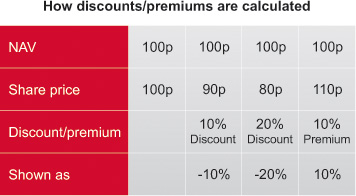
The amount, expressed as a percentage, by which an investment trust's share price is less than its net asset value per share. For example, if the net asset value is 100p and the share price is 90p, the shares are trading at a 10% discount. 

An illustration showing the calculation of a discount, typically used to explain the difference between a share price and net asset value.

Learn more about discounts and premiums

See premium.

Investing in a range of different assets to spread risk.

Income from an investment in shares. Most, but not all, investment trusts pay dividends to their shareholders.

Dividends are usually paid according to a regular schedule: quarterly, semi-annually, annually, or occasionally monthly. Dividend income isn't guaranteed and may fall as well as rise.

See special dividend.

The number of years that an investment trust could continue to pay dividends out of its revenue reserves. This is based on the current level of revenue reserves, and dividends for the current financial year. So if an investment trust has revenue reserves of £60m and is expected to pay out £30m of dividends this year, its dividend cover would be 2, indicating it could continue to pay dividends at the current level for two years, even if it received no further income from its portfolio.

Where companies publish retained earnings in place of revenue reserves, we cannot always provide a dividend cover figure. Please be aware that the current level of revenue reserves is taken from the investment trust's annual accounts and this may not include the final dividend payment (if applicable), or subsequent dividend payments.

Shows the months that dividends are likely to be declared. Please note these can differ from year to year.

The expected dividend frequency of the company. A = Annual, S = Semi-Annual, Q = Quarterly, M = Monthly.

An AIC dividend hero is an investment trust (investment company) that has consistently increased its dividend for 20 or more years in a row.

See the full list of dividend heroes here.

The annual dividends expressed as a percentage of the current share price.

If a company has paid an interim dividend of 2p, and a final dividend of 3p, and the share price is currently £1.25p, the dividend yield would be 4% (2p + 3p = 5p / 125p = 4%).

The dividend yield quoted on the AIC website is based on the total dividends expected for the current financial year. This may include estimates or forecasts. Special dividends are not included.

A dividend yield can give you an indication of the level of income you might get from an investment trust. However, the actual income you receive may be higher or lower than this, and dividends are never guaranteed.