5 A B C D E F G H I J L M N O P R S T U V W Y Z

Gearing allows investment trusts (investment companies) to magnify income and capital returns, but can also magnify losses.

At its simplest, gearing means borrowing money to buy more assets in the hope the company makes enough profit to pay back the debt and interest and leave something extra for shareholders.

However, if the investment portfolio doesn’t perform well, gearing can increase losses. The more an investment trust gears, the higher the risk.
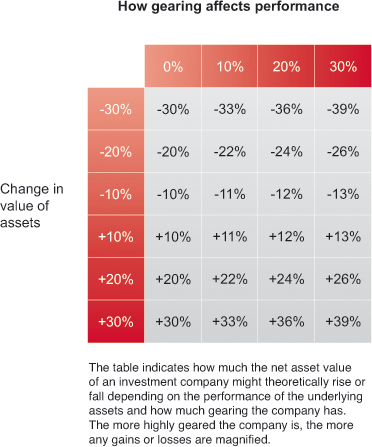
​

Investment trusts can usually borrow at lower rates of interest than you’d get as an individual. They can also gear in other ways: for example, by using derivatives or issuing special shares called zero dividend preference shares. 

Not all investment trusts use gearing, and most that do use modest levels. 

An indication of the maximum and minimum levels of gearing that an investment trust's board would expect it to have in normal market conditions.

See gearing.

The lowest and highest levels of gearing an investment trust (investment company) has had over the past three years.

See gearing.

A very common measure of the underlying value of a share in an investment trust.

In basic terms, the net asset value (NAV) is the value of the investment trust's assets, less any liabilities it has, such as gearing. The NAV per share is the NAV divided by the number of shares in issue. This will very often be different to the share price. The difference is known as the discount or premium.

A measure of the size of an investment trust. The total value of all assets held, less any liabilities (such as gearing).

A measure of how much cash an investment trust holds, after offsetting gearing. It is expressed as a percentage of net assets.

When an investment trust with cash balances also has gearing in place, any cash is first offset against the trust's gearing to give a lower gearing figure. So, if an investment trust has 10% gearing, and 5% in cash, we would say the investment trust is 5% geared with 0% net cash.

We will only show a net cash figure if the investment trust has more cash than gearing. For example, if an investment trust has 5% gearing and 10% cash, then its net cash would be 5% and its gearing would be shown as 0%.