

Dividend growth over the past five years annualised to give a compound percentage rate per year. Figures are based on the last completed financial year, meaning the last financial year for which all dividends have been declared. Special dividends are excluded but dividends paid from capital reserves are included.
The London Stock Exchange’s international market for smaller growing companies.
A meeting held once a year where shareholders can find out how their company is doing, ask questions of the directors and vote on key issues.
A report prepared by a company each year after its year end. It sets out what the company does, how it has performed over the year and its financial position.
The annual accounts will normally cover 12 months, but can be for a shorter or longer period. They typically include:
- a financial summary
- a Chairman’s statement covering issues such as performance, dividends, the company’s use of gearing etc.
- a review by the fund manager of how the portfolio has performed, any changes that have been made and its prospects for the future
- a corporate governance statement
- a detailed set of financial statements
See also interim accounts and half yearly report
Anything owned or controlled that has value. For investment trusts, this might include shares, bonds, property, cash etc.
An index or other measure against which the performance of an investment trust is compared or its objectives are set.
For example, a UK-invested investment trust might have the FTSE All-Share Index as a benchmark and an objective to outperform this. The annual report and accounts will normally include an explanation of how the trust has performed against its benchmark over the year and the reasons for any under or over performance.
See index
The price at which you sell your shares when two prices are quoted. This is sometimes shown as the ‘sell’ price and will be the lower of the two prices shown.
Also see share price
See dealing spread
The directors of an investment trust, who have a legal responsibility to make decisions in shareholders' best interests.
A typical investment trust board has four to six directors including the chairman, all of whom are non-executive, meaning they meet several times a year rather than working on the trust every day.
The board typically appoints an asset manager to manage the investments held by the trust on a day-to-day basis. The board monitors the asset manager's performance, negotiates their fees, and can replace them if performance is unsatisfactory. Investment trust boards must be independent of the asset manager, which means that a majority of directors must be unconnected with the asset manager. More commonly, all directors are independent of the asset manager.
C (‘Conversion’) shares help an investment trust grow in a way that protects the interests of existing ordinary shareholders.
When an investment trust wants to grow, it may issue C shares. These shares and the proceeds are held in a separate pool and invested in a portfolio of assets.
After a certain period, or when the pool of new money is fully invested, the two portfolios are merged and the C shares are exchanged for ordinary shares.
The advantage of C shares is that existing ordinary shareholders:
- don’t have to take up the C share offer if they don’t want to
- don’t have their returns affected while they wait for the proceeds of the C share to be invested
- don’t bear any of the issue costs
Investment trusts (investment companies) are closed-ended, which means they have a fixed number of shares in issue at any one time. The shares are traded between investors on the stock market, meaning that the fund manager does not have to create or redeem shares when investors want to buy or sell.
As well as allowing managers to take a longer-term view, this enables investment companies to invest in specialist illiquid asset classes such as private equity, venture capital and property.
See also open-ended fund
An investment vehicle where a group of investors pool their money and invest in a portfolio of assets to spread risk.
Investing in a collective investment fund can offer:
- economies of scale
All the investors pool their money and share the costs of running the fund. - a way to spread your risk
As you’re not dependent on the success of just one or two investments. - a professional manager’s expertise
The fund will employ a professional fund manager to deliver returns and to manage risk.
Shares or securities which can be converted into ordinary shares at some time in the future.
If you buy shares after a dividend has been declared, but before the ex-dividend date, the shares are said to be 'cum dividend'. Anyone who buys shares during this time will be entitled to receive that dividend.
On the ex dividend date and afterwards, anyone buying the shares won't be entitled to receive that dividend, but they will receive future dividends as long as they keep holding the shares.
See ex-dividend
The difference between the prices at which you can buy and sell shares and securities. It’s also known as the ‘spread’ or ‘bid-offer spread’.
When you buy and sell shares in investment trusts (investment companies), you may see two prices quoted:
- the higher price (the 'offer' price) is the price that you can buy the shares for.
- the lower price (the ‘bid’ price) is the price you can sell the shares for.
The difference between the two is the dealing spread.
If you buy shares, you’ll need the bid price of the shares to rise by more than the dealing spread to make a profit. The dealing spread varies between investment trusts. For example, large generalist investment trusts may have smaller spreads than more specialist smaller investment trusts.
See also share price.
The amount, expressed as a percentage, by which an investment trust's share price is less than its net asset value per share. For example, if the net asset value is 100p and the share price is 90p, the shares are trading at a 10% discount.
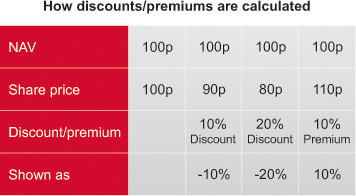
Learn more about discounts and premiums
See premium.
Investing in a range of different assets to spread risk.
Income from an investment in shares. Most, but not all, investment trusts pay dividends to their shareholders.
Dividends are usually paid according to a regular schedule: quarterly, semi-annually, annually, or occasionally monthly. Dividend income isn't guaranteed and may fall as well as rise.
See special dividend.
The number of years that an investment trust could continue to pay dividends out of its revenue reserves. This is based on the current level of revenue reserves, and dividends for the current financial year. So if an investment trust has revenue reserves of £60m and is expected to pay out £30m of dividends this year, its dividend cover would be 2, indicating it could continue to pay dividends at the current level for two years, even if it received no further income from its portfolio.
Where companies publish retained earnings in place of revenue reserves, we cannot always provide a dividend cover figure. Please be aware that the current level of revenue reserves is taken from the investment trust's annual accounts and this may not include the final dividend payment (if applicable), or subsequent dividend payments.
Shows the months that dividends are likely to be declared. Please note these can differ from year to year.
The expected dividend frequency of the company. A = Annual, S = Semi-Annual, Q = Quarterly, M = Monthly.
An AIC dividend hero is an investment trust (investment company) that has consistently increased its dividend for 20 or more years in a row.
See the full list of dividend heroes here.
The annual dividends expressed as a percentage of the current share price.
If a company has paid an interim dividend of 2p, and a final dividend of 3p, and the share price is currently £1.25p, the dividend yield would be 4% (2p + 3p = 5p / 125p = 4%).
The dividend yield quoted on the AIC website is based on the total dividends expected for the current financial year. This may include estimates or forecasts. Special dividends are not included.
A dividend yield can give you an indication of the level of income you might get from an investment trust. However, the actual income you receive may be higher or lower than this, and dividends are never guaranteed.
Also shown as ‘ex div’ or ‘xd’, this means that, if you buy the shares today, you won’t receive the most recently declared dividend.
Shares are being traded all the time on stock markets, so for administrative reasons there needs to be an agreed date when anyone buying the shares will no longer receive the most recently declared dividend. This date is known as the ‘ex dividend date’ and the shares are said to have ‘gone ex dividend’. The share price will normally fall by the amount of the dividend to reflect this.
If you buy the shares when you’re still entitled to the most recently declared dividend, this is known as the shares being cum dividend.
See ex dividend.
The regulator of the financial services industry in the UK.
The period, normally 12 months, leading up to the financial year end.
The date an investment trust will prepare its annual report and accounts to.
Gearing allows investment trusts (investment companies) to magnify income and capital returns, but can also magnify losses.
At its simplest, gearing means borrowing money to buy more assets in the hope the company makes enough profit to pay back the debt and interest and leave something extra for shareholders.
However, if the investment portfolio doesn’t perform well, gearing can increase losses. The more an investment trust gears, the higher the risk.
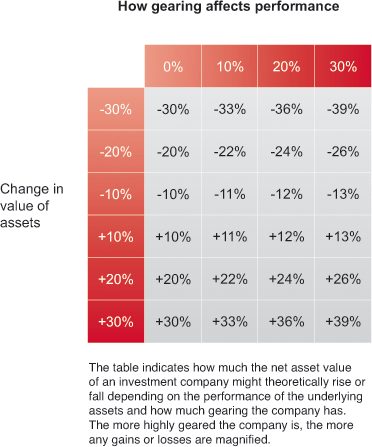
Investment trusts can usually borrow at lower rates of interest than you’d get as an individual. They can also gear in other ways: for example, by using derivatives or issuing special shares called zero dividend preference shares.
Not all investment trusts use gearing, and most that do use modest levels.
See interim accounts.
The lowest and highest levels of gearing an investment trust (investment company) has had over the past three years.
See gearing.
Illiquid investments are those that can’t be sold at short notice. This includes property, infrastructure, private equity and venture capital.
A report prepared by a company during its financial year, setting out the same type of information as its annual report and accounts, but with less detail.
Interim accounts are often the same as the half yearly report, but are sometimes issued at other times.
A company that doesn't sell products or services, but instead invests in a diversified portfolio of assets. By buying shares in the investment company on the stock exchange, investors can get exposure to the assets it invests in.
Investment companies are sometimes called investment trusts, closed-ended funds or listed funds.
Types of investment company listed on the London Stock Exchange include UK investment trusts, non-UK investment companies, venture capital trusts (VCTs) and real estate investment trusts (REITs).


